
News
A Stochastic Lagrangian Perspective on Primary Production
Žarko Kovač gave an online talk at the monthly meeting of the Simons Collaboration on Computational Biogeochemical Modeling of Marine Ecosystems.
On the 8th of April 2026 an online meeting of the Simons Collaboration on Computational Biogeochemical Modeling of Marine Ecosystems (CBIOMES) was held. CBIOMES seeks to develop and apply quantitative models of the structure and function of marine microbial communities at seasonal and basin scales. More about CBIOMES can be found here and here. CBIOMES is led by Mick Follows from Massachusetts Institute of Technology.
During the meeting Žarko Kovač gave a presentation on the ongoing work in PHOTOCLIM on the topic of antifragility in marine primary produciton. Detalis on the talk are given below, where the presentation can also be downloaded.
A Stochastic Lagrangian Perspective on Primary Production
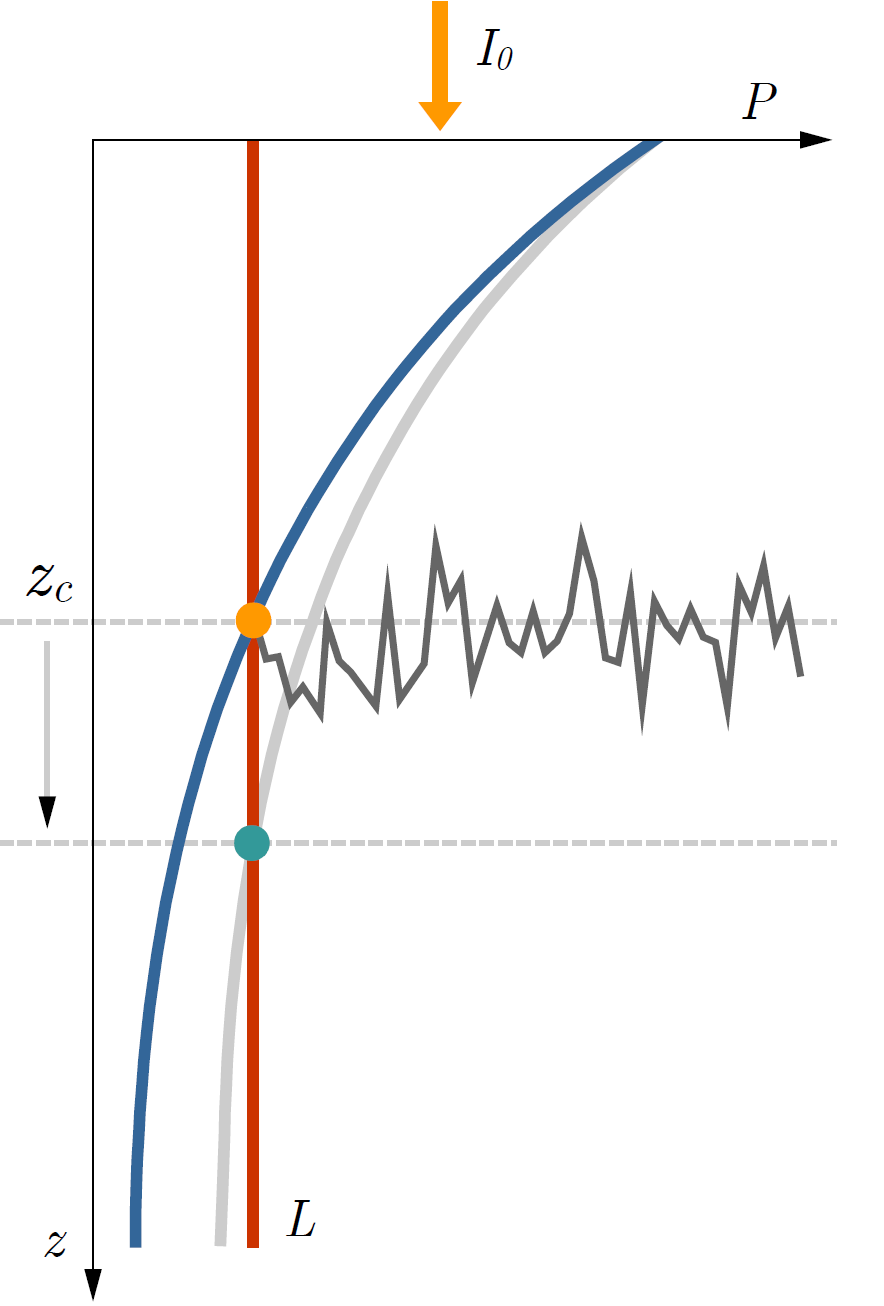
Light in the ocean decreases exponentially with depth, restricting photosynthesis to the upper, well-mixed euphotic zone. Since Harald Sverdrup’s seminal 1953 model, the critical depth has been used to describe when mixing allows phytoplankton growth to exceed losses. In this talk, we revisit this classical framework from a Lagrangian perspective, focusing on the trajectories of individual phytoplankton cells in a turbulent water column. Using Jensen’s inequality and Ito's lemma, applied on a stochastic model for vertical motion, we derive a new expression for the compensation depth that explicitly accounts for intermediate mixing. The results show that mixing can enhance primary production by effectively deepening the compensation depth. This leads to a unified interpretation: both the compensation and the critical depth emerge from a single condition, namely the depth at which average production balances losses. Weak mixing yields the compensation depth, while strong mixing yields the classical critical depth. The new probabilistic framework offers a fresh perspective on how mixing effects biological productivity in the ocean.