
News
New publication!
We have just published the following paper: Modelling primary production: multitude of theories, or multitude of languages? in the Ocean Science, coauthored by out team members: Robert Brewin., Marija Bačeković Koloper, Žarko Kovač and Shubha Sathyendranath.
Marine primary production is a key component of the global carbon cycle, with approximately 50 gigatons of inorganic carbon converted into organic carbon each year. As such, it represents an important driver of past, present, and future climate conditions. Large-scale and long-term estimates of marine primary production are primarily obtained using two types of models: satellite-based models relying on remote-sensing observations and ecosystem models embedded within ocean circulation simulations. However, significant discrepancies have consistently been identified between model outputs, including differences in estimated magnitudes and even opposing long-term trends. The interpretation of model-observation comparisons is further complicated by the limited availability of observational data, differences in measurement techniques, and continuously evolving methodologies. These uncertainties restrict the application of primary production models, particularly in the context of climate studies where reliable future projections are required.
In this work, model parameters are identified as an important but often underappreciated source of uncertainty contributing to inter-model differences. Owing to the increasing availability of satellite and in situ observations, together with advances in data assimilation and machine learning techniques, improved estimation and systematic evaluation of model parameters are now considered feasible. It is suggested that allowing parameter values to vary across space and time could help reconcile structurally different modelling approaches and improve consistency between satellite-based and ecosystem models. In addition, information derived from more complex ecosystem simulations, including nutrient distributions, temperature fields, phytoplankton classes, and vertical structure, could be used to inform simpler satellite-based models. A better understanding of parameter variability and stronger integration between modelling approaches are expected to reduce discrepancies among marine primary production models and improve the reliability of future climate projections.
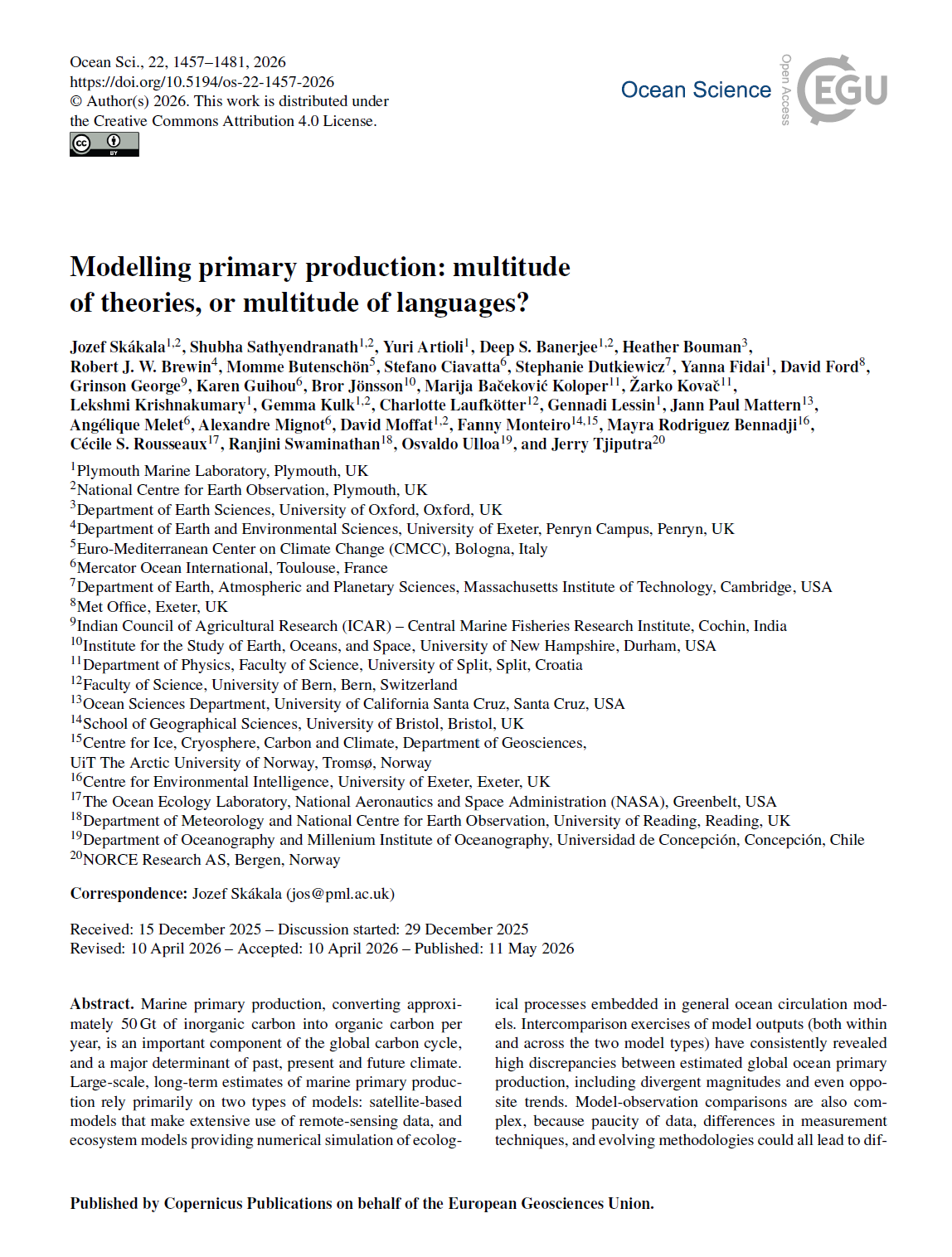
The front page of the paper is shown below:
The paper can also be accessed via this link and dowloaded below.